Garden Diary

Sunday, March 19, 2006

Yesterday we set up our St. Joseph's Table

at the parish church. This is the third year that our St. Vincent de Paul Society has sponsored the St. Joseph's table.
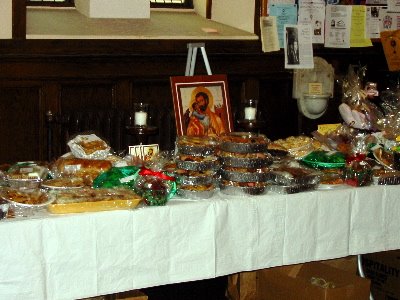


Several of us spent the week baking, and piled the table surrounding the icon of St. Joseph high with cakes, breads, cookies and candies. Most of what we bring is sold after the blessing, and that money is used to buy food for the poor of the parish; and the rest of the food is saved for the poor as well.

The blessing of the table is found in the Book of Blessings (and the Shorter Book of Blessings).

Today we honor the memory of Saint Joseph,
husband of the Virgin Mary and patron of the universal Church.
We rejoice at this table,
which is a sign of God's generous blessings
and of our call to serve the poor and hungry.
We pray that through the intercession of Saint Joseph
we too might join the saints
at the banquet of the Lord in the heavenly kingdom.

Let us pray,

All-provident God,
the good things that grace this table
remind us of your many good gifts.

Bless this food,
and may the prayers of Saint Joseph,
who provided bread for your Son and food for the poor,
sustain us and all our brothers and sisters
on our journey towards your heavenly kingdom.

We ask this through Christ our Lord. Amen.


Father David O'Donnell blesses the St. Joseph Table at Christ the King Church, Brockton

Friday, March 17, 2006

Well, enough about abstinence and fasting.

and time for recipes. Our St. Vincent de Paul Society is getting ready to host our annual St. Joseph's Altar at Christ the King parish in Brockton this weekend. So, I've been baking all week. Last night after bringing my girls home from their catechism class I made a couple of loaves of soda bread. Here's the recipe:

Irish Soda Bread

4 Cups unbleached white flour
1 tsp. baking soda
3/4 tsp. baking powder
1 Tbs. kosher salt (or 2 tsp. regular salt)
1 Tbs. caraway seeds
3/4 Cup dried currants (or raisins)
1-3/4 Cups buttermilk


Preheat oven to 375 degrees. Stir all the dry ingredients together. Add the buttermilk and mix together, adding a bit more buttermilk if needed. Turn dough onto a floured surface and knead for about 2 minutes. This can be formed into one large loaf or two smaller ones. Place loaf (loaves) on a greased cookie sheet, cut a cross in the top, and bake for 35-40 minutes (large loaf) or 25-30 minutes (smaller loaves). Let the soda bread cool on a rack for a while before cutting. Or go ahead and tear into it. Spread with butter, jam, or eat with your dinner in honor of the Saint himself. Here are some items you can put on the menu, courtesy of G. Thomas Fitzpatrick's Recta Ratio blog.
The Corned Beef Dispensation

is a topic of raging concern in St. Blogs these days. Amy Welborn's Open Book is a good example.

It would do a world of good for many of the bemoaners of our too loose discipline to read Romans chapter 14 and apply that to today.

But put on the Lord Jesus Christ, and make no provision for the flesh, to gratify its desires.
As for the man who is weak in faith, welcome him, but not for disputes over opinions. One believes he may eat anything, while the weak man eats only vegetables. Let not him who eats despise him who abstains, and let not him who abstains pass judgment on him who eats; for God has welcomed him.
Who are you to pass judgment on the servant of another? It is before his own master that he stands or falls. And he will be upheld, for the Master is able to make him stand.
One man esteems one day as better than another, while another man esteems all days alike. Let every one be fully convinced in his own mind. He who observes the day, observes it in honor of the Lord. He also who eats, eats in honor of the Lord, since he gives thanks to God; while he who abstains, abstains in honor of the Lord and gives thanks to God.
None of us lives to himself, and none of us dies to himself. If we live, we live to the Lord, and if we die, we die to the Lord; so then, whether we live or whether we die, we are the Lord’s. For to this end Christ died and lived again, that he might be Lord both of the dead and of the living. Why do you pass judgment on your brother? Or you, why do you despise your brother? For we shall all stand before the judgment seat of God; for it is written, “As I live, says the Lord, every knee shall bow to me, and every tongue shall give praise to God.”
So each of us shall give account of himself to God. Then let us no more pass judgment on one another, but rather decide never to put a stumbling block or hindrance in the way of a brother.
I know and am persuaded in the Lord Jesus that nothing is unclean in itself; but it is unclean for any one who thinks it unclean. If your brother is being injured by what you eat, you are no longer walking in love. Do not let what you eat cause the ruin of one for whom Christ died. So do not let your good be spoken of as evil.
For the kingdom of God is not food and drink but righteousness and peace and joy in the Holy Spirit; he who thus serves Christ is acceptable to God and approved by men. Let us then pursue what makes for peace and for mutual upbuilding.
Do not, for the sake of food, destroy the work of God. Everything is indeed clean, but it is wrong for any one to make others fall by what he eats; it is right not to eat meat or drink wine or do anything that makes your brother stumble.
The faith that you have, keep between yourself and God; happy is he who has no reason to judge himself for what he approves. But he who has doubts is condemned, if he eats, because he does not act from faith; for whatever does not proceed from faith is sin.
We who are strong ought to bear with the failings of the weak, and not to please ourselves; let each of us please his neighbor for his good, to edify him. For Christ did not please himself; but, as it is written, “The reproaches of those who reproached thee fell on me.” Romans 13:14-15:3


While in Boston we get this respite from the fasts of Lent today, Archbishop O'Malley has requested all Catholics to attend daily Mass and fast every day during Lent. How much support he has received from his clergy I don't know (Have there been sermons where fasting and daily Mass was suggested to the people? Have pastors scheduled early morning or evening Masses so that workers can attend Mass?) but the Lenten discipline being suggested is certainly far more rigorous than you would suspect. But because it is suggested rather than demanded, some folks think it too easy.

To put that in perspective, it's worth noting that the more rigorous Orthodox (and Eastern Catholic) fasting rules are (to quote the pirate captain in Pirates of the Carribean) "not exactly rules; they're more like guidelines." As Rev. Thomas Hopko writes:

The Orthodox rules for lenten fasting are the monastic rules. No meat is allowed after Meatfare Sunday and no eggs or dairy products after Cheesefare Sunday. These rules exist not as a Pharisaic "burden too hard to bear" (Luke 11:46), but as an ideal to be striven for; not as an end in themselves, but as a means to spiritual perfection crowned in love. The lenten services themselves continually remind us of this.

Let us fast with a fast pleasing to the Lord. This is the true fast:
the casting off of evil, the bridling of the tongue, the cutting off
of anger, the cessation of lusts, evil talking, lies and cursing. The
stopping of these is the fast true and acceptable.
(Monday Vespers of the First Week)


The lenten services also make the undeniable point that we should not pride ourselves with external fasting since the devil also never eats!

The ascetic fast of Great Lent continues from Meatfare Sunday to Easter Sunday, and is broken only after the Paschal Divine Liturgy. Knowing the great effort to which they are called, Christians should make every effort to fast as well as they can, in secret, so that God would bless them openly with a holy life. Each person must do his best in the light of the given ideal.

Thursday, March 16, 2006

The Communion Fast

as all Catholics know is that no food or liquids other than water can be consumed for one hour before communion. However, this a greatly mitigated form of the communion fast that was in place until the 1950s. Prior to that, the fast was from all foods and drinks, water included, from midnight until the communion. Father William Saunders, in an article writing in the Arlington Catholic Herrald gives a good short history of the communion fast and the reason for it.

As he notes, the communion fast is regulated in canon law. The canon reads in full:

Can. 919 §1 Whoever is to receive the blessed Eucharist is to abstain for at least one hour before holy communion from all food and drink, with the sole exception of water and medicine.

§2 A priest who, on the same day, celebrates the blessed Eucharist twice or three times may consume something before the second or third celebration, even though there is not an hour's interval.

§3 The elderly and those who are suffering from some illness, as well as those who care for them, may receive the blessed Eucharist even if within the preceding hour they have consumed something.


For most Catholics, it is section 1 of the canon which regulates our behavior. Note that the fast is to be for at least one hour before communion. In other words, the Church has allowed each individual to make a determination about how long the fast should be given his condition.

A person with a full night's rest, no unusual physical needs, etc. should have no problem following the ancient discipline of fasting from midnight on. Those engaged in work overnight might be placing their work and even their lives in jeaopardy by doing so, as hunger could lead to faintness and accidents, and so a shorter fast would then be appropriate. But the received tradition of the church is to fast in order to purify ourselves, and to stir up a holy hunger for the bread of life and the cup of salvation.

Each person is allowed to judge for himself, but as with any other decision, we should be informed by the practice of the Church which is not only the living but also those who have gone before.

Wednesday, March 15, 2006

Abstinence on Fridays and the reasons thereof

With St. Patrick's Day quickly approaching, the question of "Do I have to abstain from meat?" has been raised at least across the United States. This article in the Washington Post notes that the bishops of at least 60 dioceses in the U.S. (out of 200) have granted a dispensation allowing the eating of meat on Friday, March 17 this year.

At our after Vespers coffee klatch on Sunday, one of the congregants just couldn't understand this. She was vehement that she wouldn't be serving meat on a Friday in Lent. Why not just translate the feast day to another day. I began to explain that it couldn't be moved, but as a discussion began on that I realized it was just, barely possible that my fellow congregant didn't find the minutiae of the ranking of liturgical days nearly as interesting as I do ;) So we got off that topic.

The Post article quotes one fellow who says:

If Dolan hadn't granted the dispensation, O'Leary, director of Milwaukee's St. Patrick's Day parade, said he would stick to the rules _ meaning he wouldn't prepare his corned beef brisket. But with the bishop's blessing, he plans to put a brisket in his slow cooker early Friday morning and slather it with mustard and other condiments come dinner time...

"It is being done in honor of St. Patrick," O'Leary said. "It's not as though I'm having something I would normally have. It's a special thing."...

In exchange for his corned beef meal, O'Leary said he plans to give up something else, such as chicken wings or beer on a weekend when he's watching sports on television.

"I will deny myself something and pay it back," O'Leary said.


The only problem with this otherwise admirable willingness to follow the rules is that it insinuates that the only reason to abstain from meat is to follow a rule. And of course that is not why we do it. The rule is to remind us to identify, through personal sacrifice, with the sacrifice of Christ. It's not something we do because we owe it...so that we can deny ourselves some other treat. It's that we are to "put on the Lord Jesus Christ, and make no provision for the flesh, to gratify its desires." (Romans 13:14)

Another person, Jim Wharton, spokesman for the Sioux City Diocese, quoted in the article stated:

"For the most part, I think people understand it's really why we are who we are as a Catholic family and that's to observe some of the traditions of the church."


Again, it's great and wonderful that we have traditions that bind us and unite us, but that is also not the reason we abstain; it's a reason we all abstain on the same day, instead of being told "abstain once per week, you pick", and it certainly has value as a means of identifying with the community. But I wonder: have we, through our general abandoment of fasting and penance in the Latin church, forgotten the meaning for it to the point where even the observant are not benefitting from this ascetical practice?

Thursday, March 09, 2006

The Fasting Season

of the Church has begun. And confusion reigns. On the bulletin board of one local parish where I went for daily Mass today I read a notice from the pastor which read, in part, "Abstinence (i.e, no meat) is required of everyone over 14 on the Fridays of Lent, and fasting for everyone 21-59."

Well, no. Fasting is required only on Ash Wednesday and Good Friday, and the ages are 18-59.

I also picked up a copy of a letter from Archbishop O'Malley.

The text is below:

By virtue of the power to dispense as granted by Canon 87.1 and Canon 88,
I, the Archbishop of Boston, hereby grant a dispensation from the
obligation of abstinence for all the
Faithful of the Archdiocese of Boston on
Friday, March 17, 2006 in honor of the
Feast of St. Patrick,
the Patron Saint of the Archdiocese of Boston.


Now, Canons 87.1 and 88 do give the ordinary the power to dispense from universal disciplinary laws and from local laws. Canon 1250 establishes the basic law for abstinence thus:

All Fridays through the year and the time of Lent are penitential days and times throughout the universal Church.


Canon 1251 makes this more specific.

Abstinence from eating meat or another food according to the prescriptions of the conference of bishops is to be observed on Fridays throughout the year unless they are solemnities; abstinence and fast are to be observed on Ash Wednesday and on the Friday of the Passion and Death of Our Lord Jesus Christ.


Now, for some background, when Archbishop O'Malley was bishop of the neighboring diocese of Fall River, he was challenged on the rule of Friday abstinence for St. Patrick's Day. He initially held firm, but faced such a loud cry of opposition from people unwilling to do penance by putting off for a day their corned beef and cabbage that he issued a decree similar to the one above.

Here in Boston, there was no controversy that year, because, as the Archbishop noted, St. Patrick is the patron saint of the Archdiocese. That means that in this Archdiocese, St. Patrick's Day is a solemnity, the solemnity of the proper patron. And as Canon 1251 notes, it is therefore not a day on which abstinence is required.

What this all means is A) the rules change too often even for many pastors to keep up with and B) people are so unaware of the Church's canons and the reasons for them that they have to be dealt with more simply, such as the Archbishop's letter above (no doubt influenced by the ruckus in Fall River years ago).

And for those who are fasting in some way throughout Lent, there are two other solemnities that ought not to be days of fast/abstinence: March 19, the feast of St. Joseph and March 25, the feast of the Annunciation to Our Lady. So, from Friday March 17 until Sunday March 20 there are only 5 days when fasting need be done, since Sunday is also not a day for penance. A bit of a break mid-Lent, to remind us of the joy that awaits.

Wednesday, March 08, 2006

Dinner at home

last night was late. My youngest daughter had her usual Tuesday afternoon figure skating practices, and my wife was working her Tuesday night shift at the library, so when we got home about 6:45 pm I started in on preparing dinner. I have, so far, managed not to give in to the temptation to use "instant foods" and lots of takeout, and so dinner took about 35 minutes to prepare. We finally got to sit down about 7:20, and my two daughters and I worked our way through a typical family meal: saying grace, listening to "that's the weirdest thing I ever saw", talking about school and people we know. Near the end, I leaned back and thought how nice it was that neither of my daughters was in a rush to go off somewhere else.

Each tried a bit more food, then we finally broke things up, started unloading the dishwasher so that we could load it with the dinner dishes, putting away food, etc.

Family meals don't seem strange in the least to me. We have always had them almost every evening since my wife and I first married; my parents did the same, as did my wife's family; and so did our grandparents. But I know from talking with my daughters that many of their friends encounter family meals as an unusual event. Maybe that's why some of their friends have eaten with us so often. (As it turns out, one of the friends turned up for tonight's dinner.)

One of the rules we have about dinner is that we don't answer the phone while at table. I remember a minister's daughter who was a friend in high school had that rule, and I thought that it was harsh...now, having a family I realize it was prudent on the part of the minister/father. We can hear any number of complaints about how family life is intruded upon if we look in the papers or magazines or surf blogdom. But no one makes you pick up the phone or turn on the TV. Leave these electronic servants where they belong: in the background, ready for our commands.

It reminds me of the many eating scenes of the officers' mess aboard ship in the Patrick O'Brien Master and Commander series. While the officers ate, each had an attendant stationed behind, ready to fill a glass or otherwise come to the aid of an officer. While few of us in the U.S. have servants like this, we all have the mechanical servants which we too often allow to rule instead of serve.

Oh, and the menu. Inspired in part by the title story from Theresa Lust's collection of writings from the kitchen Pass the Polenta, we had a bowl of polenta, with a tomato/mushroom stew along with a loaf of Italian bread I picked up at the supermarket bakery. Recipes below:

Tomato and Mushroom Stew

2 Tbs. oil
1 medium onion, chopped
1 large red bell pepper, seeded and chopped
3 cloves garlic, peeled and crushed
12 oz sliced mushrooms
1 14-16 oz can diced tomatoes
2 tsp. oregano
2 tsp. basil

Heat oil and add onions and garlic, until onions are limp and garlic browned. Add bell pepper and mushrooms and continue to sautee. Finally add entire can of diced tomatoes and herbs. Allow to "stew" on low heat for 20 minutes.

Polenta

4 cups water
2 cups corn meal (a nice whole corn meal like Hodgson's Mill is good)
1/2 tsp. salt

Add corn meal to cold water is sauce pot. Bring to slow boil, stirring frequently. Once this the mixture is thickened, turn the heat down and let cook for 10-15 minutes.

Optional: you can add 1/2 cup shredded cheese (mozzarella or cheddar or paremsan) to this if you're not avoiding dairy products for Great Lent.


Scoop some polenta onto a plate when done, and ladle tomato & mushroom stew on top. Serve with a crusty bread (to help sop up the stew).

Friday, February 24, 2006

After Church Coffees

Catholic parishes are not known for hosting after Church coffee hours, although the two parishes I usually go to, Holy Trinity in Boston's South End and St. Athanasius in West Roxbury, both host coffee hours.

The social benefit of the coffee hour is obvious. But does it serve any evangelical purpose?

I think so. Particularly when we have evening services, which attract more non-parishoners, the coffee hour (well, it's more of a sherry hour in the evening, but heck, it is an Anglican use parish) gives the excuse to pause and converse, but also the chance to meet new people and give people the opportunity to ask questions. We're urged in Scripture to ever be ready to give a reason for the hope that is in us, and it certainly doesn't hurt to create situations where that reason might be inquired into.

The community-building afforded by a coffee hour is also more than social. It is a time when we learn of the burdens our fellow parishoners which we can then help bear, at the least in prayer, and when we learn of their joys, which we can lift up as well.

While some churches may find the logistics of putting on a coffee hour difficult, such as having no facility other than the church building, or offering back-to-back Masses all morning long on a Sunday, there are many more that will not have these kind of roadblocks, but instead just need to get going.

What's a good way to start? I think the following formula will help:

1. Have a sexton or other person actually prepare the coffee each week. Some people find percolators difficult or just out of their experience.

2. Buy decent coffee!

3. Have another person be in charge of the cups, napkins, plates, etc. Multiple people in charge will likely result in shortages.

4. Have a rotating schedule of people to bring something to eat and drink (such as juice and cream for the coffee). If it is a large parish, have two or more families scheduled each week.

5. Commit to a regular, weekly schedule. If coffee hours are once a month, or on moving dates, people won't know about it, especially new comers.

6. At coffee hour, look for new comers and invite them into conversation. Don't keep to the same groups of people. This isn't high school--no cliques!

Thursday, February 09, 2006

Feeding the Hungry

I've been a member of the St. Vincent de Paul Society at the local parish since July of 1999. And a major part of what we do is bring food to the poorer families of the parish. Some of the families we'll visit in the next month or so are families that I visited in 1999; and some of them were being visited by Vincentians from the parish for many years before that.

When we go on a visit to one of these neighbors, we might bring 4-6 bags of groceries: pasta, rice, instant mashed potatoes, canned soups, macaroni & cheese, canned beans, fruits and vegetables, boxes of cereal and oatmeal, canned tuna and chicken, frozen hamburger and chicken, bread, etc. We aim to provide at least 4-5 days of meals for the family, but are constained as to what we give by what's available at the Greater Boston Food Bank of which we are members, and what we collect in various food drives at the parish.

Last night we had an information meeting for people who are interested in becoming part of the group. Among the things we told them is that taking on this apostolate is going to be an emotional experience. There will be times when we feel we have made a real difference in people's lives; where we have been empowered by God to go beyond giving a handout and established some real fellowship with the people we visit. There will be other times when we are heartbroken--where our best efforts are unable to help someone, whose situation might even become worse.

But we struggle to maintain our covenant with these poorer neighbors. We continue to visit. And bring the groceries. If we can do more, help one person get their citizenship, help another find work to sustain himself and his family, we are happy to do so. But we have also learned that while it is better to teach a woman to fish than to give her a tuna sandwich, the tuna sandwiches are greatly appreciated by a mom until her catch is sufficient to supply her children's needs.

Friday, January 20, 2006

Happy Ending

At the end of The Wonder Worker Alice has overcome her food addiction; finding confidence in her abilities and respect and love within her social circle has made the need for anesthetizing herself far less urgent. The healing she wondered about in the quote below had, of course, only begun; by the end of the novel, it was greatly progressed. Healing, such as she experienced in Howatch's story never finishes of course--it is a lifelong process in which God makes right what has gone wrong, where the mountains are leveled and the valleys filled in. The seemingly bottomless valley of self-hatred and despair for the future which Alice tried to fill with food and its comforts has been made a straight way by a healing.

And of course, it happened without directly attacking her eating habits, which were only a minor part of her problem, and were more in the line of symptoms than causes. This is not unusual; the way to solve a problem often lies in addressing a deeper problem that may not be obvious at all.

But what of the food that is, in a novel with a Cordon Bleu cook as a central character, a main feature? All that talk of roasts, puddings, has me wondering where to find the recipes for these dishes. When I find them, I'll report back.

I read a different series of books, by Patrick O'Brian, last year, and food was a staple in that narrative as well. If you haven't read these books (20 finished and 1 left unfinished at the author's death) do so...they are marvellous. Someday I'm planning on going back through to make a note of all the times Maturin (a Catholic amidst a mostly Anglican crowd) turns into a church or monastery to listen to and rhapsodize on Gregorian chant. The movie Master and Commander: The Far Side of the World is also great. The burial at sea scene, with the crew reciting (in toto) the Our Father is a moving moment.

Fortunately, for those interested in things culinary, a pair of authors decided to track down the recipes for all of the dishes mentioned in the Aubrey/Maturin books like Master and Commander and The Far Side of the World (despite the movie title, these are two different volumes, 1 and 10 respectively) and have published them in the book Lobscouse and Spotted Dog. This past weekend I decided to make the eponymous Spotted Dog, which is a boiled pudding. The resulting pudding (which is nothing like what we Americans call a pudding) is something like a sweet raisin bread. It has something in common with Irish Soda Bread (which was originally cooked in a pot over a fire, but without the boiling). We enjoyed it at home with creme anglaise, and I brought some in for my coworkers who also enjoyed it. Here's the recipe:

4 cups flour
1/4 cup sugar
1 tsp. cinnamon
1/4 tsp. nutmeg
1 tsp. baking soda
1 cup currants
1/2 pound beef suet
2 eggs (slightly beaten)
1 cup milk

Mix the dry ingredients together, making sure to separate the currants. Grate the suet (cleaned of any connective tissue or meat) and mix with the other dry ingredients. Add the eggs and milk, and stir together, finishing with a light kneading on a floured surface. Put in a greased pudding mold (I used a stainless steel mixing bowl) and cover with a floured cloth (a bar towel would work, although I used cheesecloth) tied tightly with a string. Put in a pot of boiling water (with a plate at the bottom so the mold or bowl doesn't come directly into contact with the heat), cover loosely and cook for about 2 hours. Turn out on a plate and serve slices with creme anglaise, sweetened condensed milk, dulce de leche or hard sauce.