Garden Diary

Thursday, February 08, 2007

Ash Wednesday is fast approaching
and it's a good idea to begin assembling Lenten recipes. One good online source of recipes that might not occur to you immediately is Meriadoc's Miscellany. This online book from members of the Society for Creative Anachronism (SCA) has lots of recipes. Because the SCA is very interested in Medieval European customs, which included much stricter fasting practices, many of the recipes are very good for Lent.

With Lent beginning in the cold of February, meals of hot soup and bread are seasonally as well as penitentially appropriate. The first recipe we'll look at is Rapes in Potage.

The recipe in the Miscellany is:

1 lb turnips, carrots, or parsnips
2 c chicken broth (canned, diluted)
1/2 lb onions
6 threads saffron
3/4 t salt
powder douce: 2 t sugar, 3/8 t cinnamon, 3/8 t ginger

Wash, peel, and quarter turnips (or cut into eighths if they are large), cover with boiling water and parboil for 15 minutes. If you are using carrots or parsnips, clean them and cut them up into large bite-sized pieces and parboil 10 minutes. Mince onions. Drain turnips, carrots, or parsnips, and put them with onions and chicken broth in a pot and bring to a boil. Crush saffron into about 1 t of the broth and add seasonings to potage. Cook another 15-20 minutes, until turnips or carrots are soft to a fork and some of the liquid is boiled down.


To make this suitable for Lent, substitute vegetable broth for the chicken broth; and if saffron is beyond your budget, you could add 1/4 tsp turmeric, but a better idea is to look in the Spanish/Mexican section of your grocery store. The spices in that section are usually cheaper than in the "regular" spice aisle or the baking needs aisle, and saffron is a common spice in Spanish cooking. We've used Goya brand and found it quite suitable. You can also check in some of the larger dollar stores; around the Boston area, the Ocean State Job Lots have large spice areas, although I'm not sure if you'll find saffron there (but you will find the cinnamon and ginger). Also note that the original recipe from which the Miscellany's was derived, called for three vegetables: turnips, carrots or parsnips, and water parsnips. The latter are near impossible to find, but the first ingredients are plentiful, so perhaps having 1/3 pound of each would be a bit more authentic (and tastier too).

To go with this soup, a nice bread is in order. This recipe is called "Tear (as in cause a hole, not as in weeping) Bread" because it's brought to the table in a whole loaf and everyone tears off pieces.

1 tsp yeast
1/2 tsp sugar
1/2 cup warm water
3 cups flour
1/2 tsp salt
1/2 cup warmed milk (substitute almond or soy milk in Lent)

add yeast and sugar to a bowl, pour in warm water (around 95 degrees) and let the yeast begin to proof (i.e., bubble). Add flour, salt and once mixed slightly, add warmed milk. Continue to stir and add more flour as necessary.

Knead the dough for 7-8 minutes and place in a bowl covered with a towel for about 1-1/2 hours. After the dough has risen, punch down and knead for 2-3 minutes and form into an oval loaf. Put this on a cookie sheet dusted with corn meal or on a baking stone dusted with corn meal. Slash the top of the loaf and cover to rise a second time (about 1/2 hour). Preheat oven to 375 degrees and bake for about 20-25 minutes. Let the loaf sit about 15 minutes before serving and bring to the table to be torn into ; )


If you want to use this recipe for festive occasions outside Lent, you can add 1/4 stick softened butter and an egg, and adjust the amount of flour upward as needed.

Friday, February 02, 2007

You know we're nearing the beginning of Lent

when bloggers begin talking about fasting. Over at The Continuumthere's a new discussion about Orthodox fasting practices and a link to St. Nectarios Press cookbooks that can be useful in preparing food in the distinct mode that the elimination of meat, wine, dairy, eggs and oil requires.

One useful trick is to use soy milk instead of milk both for over breakfast cereal and in baking. If you want to follow fasting rules strictly and have no oil, you may have to read the ingredients label, as most soy milks have some oil. But buying soy milk is a whole lot easier than making your own almond milk, which was the solution that our medieval forebears came up with. You can buy almond milk, but it's rather pricey, and could interfere with your almsgiving, which wouldn't be a very good thing to do during Lent.

Saturday, December 30, 2006

A Christmas Pudding

is waiting in the refrigerator, developing its flavors and asking for nothing more, as it prepares itself to be the piece de resistance of our dinner tomorrow, than a few drops of brandy now and again to refresh itself.

I had hoped to have the pudding ready for Christmas day itself, but it took weeks to track down some suet, my local butcher being of no help to me at all, and once I had finally found it, I didn't have the time prior to Christmas to spend at home while it steamed away.

Finally on Wednesday this week I did get that chance, and so while the pudding will be a bit young, I did reserve enough suet to make next year's pudding, and perhaps even enough to make a nice Spotted Dog for Carnival.

The pudding recipe I used is from Grossman and Thomas' Lobscouse & Spotted Dog, a link to which can be found on the right. The recipe follows below.


1 Cup flour
1 Cup sultanas
2 Cups soft, fresh bread crumbs
Zest of 1/2 lemon, coarsely chopped
1/2 Cup dark brown sugar, firmly packed
1/3 cup candied orange peel, coarsely chopped
1/2 teaspoon salt
1/3 Cup candied citron, coarsely chopped
1 teaspoon ground cinnamon
3/4 Cup slivered almonds
1/2 teaspoon mace
1/4 pound suet, finely grated
1/2 teaspoon ground nutmeg
3 eggs, lightly beaten
1/2 teaspoon ground ginger
3/4 Cup brandy, plus 1/4 Cup for flaming (optional)
1/4 teaspoon ground cloves
1 Cup raisins
1 Cup dried currants

In a large bowl, combine the flour, bread crumbs, sugar, salt and spices. Stir in the fruits and nuts (the flour and bread crumbs will coat the fruits and prevent them from sticking together). Mix in the suet, then add the eggs and 1/2 cup of the brandy. Work the mixture thoroughly with your hands.

Scrape the batter in a greased 6-Cup pudding basin (I used a small stainless steel bowl). Tie a well-floured cloth (cheese cloth works for this), allowing a little room for expansion. Place the pudding in a pot of boiling water, cover, and steam for 5 hours or longer. (Explanation: I put a small ceramic plate, face down, on the bottom of the pot, to raise the pudding basin, i.e, the steel bowl, over the bottom of the pot to keep it from burning. You don’t cover the pudding basin...have the water 1/2 to 3/4 up the side of that...you cover the pot, to keep in the steam.) You will almost certainly need to add more boiling water as it cooks. (Hint: Keep a tea kettle full and simmering along on another burner so you have the water to add to the steam pot.)

Take the pudding out of the water and let it cool. Remove the cloth and pour in the remaining 1/4 Cup of brandy. Cover tightly and store in a cool place for 3 weeks or longer.

To prepare for serving, uncover the pudding, tie it up again in a floured cloth, and steam it for at least 2 hours. Remove it from the pot, untie the cloth, and unmold onto a serving dish.

Decorate with sprigs of holly, and serve flaming as follows: Warm 1/4 Cup of brandy in a small sauce pan, pour it over the pudding, set it alight, and serve it forth accompanied by Hard Sauce.

Serves 6 to 12.

Monday, November 20, 2006

Celebrating the feast days of the Church

with food made especially for the occasion is one of the reasons I started this blog. For those who have checked out A Continual Feast which I described earlier (see the sidebar for a link), the riches of Christian festal celebrations are obvious.

I recently came across another cookbook, this one an online version of a 1950's book entitled Feast Day Cookbook in the EWTN library. Like A Continual Feast, this book has lots of recipes for individual saint's days, as well as seasonal recipes, along with background information on the seasons and days.

The only problem with the book is that the formatting is a little primitive; while that wouldn't be a problem for an individual recipe, the plain ASCII file would be tough to print in full. I'm hoping to clean it up and make a PDF version to post here, but as an appetizer, as it were, I have made up a PDF of most of the December recipes, which you can download.

Tuesday, October 10, 2006

A coffee hour brouhaha

has erupted over at the Mere Comments blog. While the original post had a very negative view of them, the majority of responses (37 at the point I looked in) were positive. It seems to me that the possible abuses (cliques forming and some people being left at the sidelines) can be avoided by becoming aware of them, and then striving to eliminate them.

In addition, if it is a problem that some people might be left on the sidelines at such events as after worship receptions, I don't see how banning such receptions will solve the problem. People who are shy and who don't easily break into exisiting social networks are not going to find it easier to do so if there are no opportunities provided to meet with people. Such folks will simply attend to worship and then go away. If fellowship outside of worship is something they need, they won't get it by banning receptions. The cure is the harder task of making receptions truly welcoming to the newcomer and the shy.

Thursday, July 20, 2006

Two of the legacies that I have from my dad

are a love of fishing and of gardening. Many of his friends would readily recognize the first and be astounded at the second. But for several years as a kid my dad and we kids maintained a large garden at home. Large enough so that my Mom took up canning, putting up dozens of jars of pickles and tomatoes and spaghetti sauce. It was from Dad that I learned about composting, about putting a fish carcass under corn and squash hills (which we of course got from the local lore descended ultimately from Squanto, that Catholic-Indian savior of the Pilgrims).

And both activities, fishing and planting have often given me what I hope are decent insights into many of the parables of Christ, and a definite feeling of closeness with the original disciples and apostles, who were, for the most part, men of the earth and seas.

But gardening is a topic especially appropriate for this blog. This year I added yet another vegetable bed to our gardens. One bed has pole beans and bush wax beans (and so far the pole beans have escaped the scourge of the Mexican bean beetle, which devasted my crop the last time I planted them), another to herbs and cucumbers.


In the front yard, an 8 x 8 bed holds tomatoes and peppers. Another bed has purple eggplant and a rainbow of Swiss chard. A third bed has tomatillos, and spaghetti, crookneck and zucchini squash, as well as sunflowers. And this year I dedicated two boxes to corn.


I've always thought that it was a great waste to own property, but not raise food. Aquinas posited that property is proper to man, and that because it is necessary to the maintenance of human life, at least of the civilized variety, and good order among men. And that so directly contributes to the maintence of life than the provision of food. In America today, where less than 2% of the population is engaged in farming, it can be far too easy to forget that food is the product of human labor, and not just a commodity to be purchased with money.

Wednesday, June 21, 2006

Not much blogging time lately,

as I have been very busy with the rest of my family laying my dad, Ron Cavanaugh, to rest. Dad died on June 2, 2006, while preparing to leave Florida to come back to Massachusetts for the summer.

The only food related item from the past few weeks worth thinking about was my sister Laurie's work. Following my dad's death, I flew down to Florida to help mom out, and my sister, who also is in Mass., was calling several times a day. Like most of the family, she was upset by the sudden death, and also by her inability to do anything. Finally, I gave her some assignments, to prepare food for the Friday before the planned funeral so that the family, the six of us children, plus spouses, children and Mom, would have plenty to eat.

This calmed her down somewhat, and she set to work planning a meal of baked ziti, chicken divan, meatballs, etc. It was, on one level, just something to do, but on the other, it is very satisfying to be able to feed people. No matter what is going on, people need to eat, and providing the kind of staple foods that my sister came up with, foods both familiar and nourishing, was just what was needed as we gathered together, in the biggest get together we've ever had as a family. Preparing this meal was ministering on not just the physical plane, but on the psychological as well. An example of ministry and therapy combined.

Monday, May 22, 2006

Another group that spends lots of time feeding the hungry are the Catholic Workers. They have houses of hospitality throughout the world. The "St. Joe's" column from the most recent The Catholic Worker paper from the New York houses of hospitality begins with the following:

by Matt Vogel

People sometimes joke that everything that happens at St. Joseph House has to do with food. And well, there is quite a bit of truth to that. Tuesdays, Wednesdays, Thursdays and Fridays, we get up, cook the soup, serve the soup and clean up from the soup. Everyday, we cook lunch, eat lunch, clean up from lunch, then cook dinner (for both St. Joe's and Maryhouse), eat dinner and clean up from dinner. Sundays, we even have a wonderful brunch. (We, naturally, don't want to look out of place amongst the hip restaurants in our increasingly gentrified neighborhood!) In between, we spend time hauling around crates of food--usually donated vegetables, bread and sometimes canned goods. When we do sit around talking, playing cards or watching TV, there is usually food involved. And, of course, food is always a central ingredient at all our parties--birthday parties, holiday parties, etc There is no question, food is a major part of life here.


Anyone who works with the poorer of our neighbors could probably write much the same thing. Once shelter of some kind is secured, the biggest item of the day, every day, is securing food. A week ago our St. Vincent de Paul conference participated in the annual Postal Workers' Food Drive. It is a long day, that ultimately nets our conference around a 1000 pounds of food. That doesn't last very long (about two weeks) but it is a big help. This year several of our new members took part in the food drive, and our pantry is still full of boxes, with literally everthing from soup to nuts!

And a good thing too, as my van is in the shop (and has been for most of the past week) with some strange problem with the back axel. The mechanic finally asked if I do much hauling in the van, and when I replied, why yes, once or twice a month I fill the back with 1400 pounds of food or so, he looked rather shocked! He suggests that that could be a problem. Well, it has done a number on the shocks, that's for sure. But with the extra food from the Postal Workers, I don't have to worry about not being able to make a second food run this month.


The Catholic Worker is not available online, else I'd provide a link. Some Catholic Worker houses are online, however, such as Bob Waldrop's Oklahoma City CW house. Bob's Better Times Almanac has several great sections on food, from how to be a more frugal shopper to a great book of recipes. Parts of his Family Food Security and Casino Shopping pages were made into a brochure called "Better Shopping" which you can download from our District SVDP site.

Thursday, April 06, 2006

The New York Times has taken notice of the family meal

and notes that at least some some surveys indicate that the number of families sitting down for a meal together several times per week has been increasing over the last few years. That's great news! As I blogged earlier, that's something we do often, and it's perhaps the one thing I miss most from our children's younger days, when all five of us gathered around the table. No, it was not always a calm, relaxing time, but it has been formative, for both parents and children, and has been one of the principal forges of the bonds between us. Now that my son Patrick is away at school, we have fewer meals with everyone together. And while we eat together nearly every day, it's sometimes only two of us.

I also feel that it's important that the family meal consist of food prepared by the family. Take out isn't the same. This past week we had mostly restaurant meals and takeout for five days straight because of skating competitions, church events, and the usual run of music lessons and skating practice. I was notably more grumpy than usual!

Last night we got to have a (late for us) sit down meal that Laurie and I collaborated on. Finally! It makes a difference to have food prepared in the house by a member of the family. I've been happy to see my daughter Molly start making meals on Thursdays, the one day she doesn't work or have to go to her college class, not only because it gets me off the hook : ) but because she's gradually learning an important skill that will be a blessing for her own family some day.

Here's last night's recipe, Lenten fast appropriate:
Italian-style Shrimp

1 large bell pepper, chopped in bite-sized pieces
1 large yellow onion, chopped as above
6 asparagus spears, cut into 1-inch lengths

2 Tbs. peanut or canola oil

1-2 pounds shrimp, shelled

2 tsp. crushed red pepper
2 tsp. oregano

1 pound angel hair pasta


Set a pot of water to boil. Heat a wok or large skillet and when hot add the oil. When the oil is hot, add the peppers and onions, and stir for 4-5 minutes. Add the shrimp, crushed red pepper and oregano, and stir. Add 2 Tbs. water. Cover for 2-3 minutes. Uncover and stir, then cover again.

Now, add some salt to the boiiling water, then cook the angel hair pasta in the boiling water. After 4 minutes or so, drain the pasta, arrange in a pasta bowl, and spoon the stir fry over the pasta. Serve with Italian or any crusty bread.

Sunday, March 19, 2006

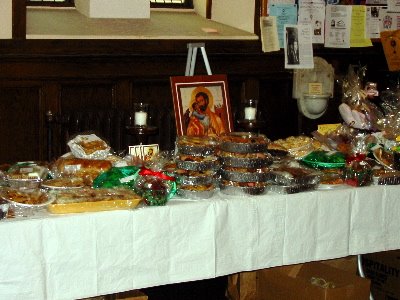
Yesterday we set up our St. Joseph's Table

at the parish church. This is the third year that our St. Vincent de Paul Society has sponsored the St. Joseph's table.


Several of us spent the week baking, and piled the table surrounding the icon of St. Joseph high with cakes, breads, cookies and candies. Most of what we bring is sold after the blessing, and that money is used to buy food for the poor of the parish; and the rest of the food is saved for the poor as well.

The blessing of the table is found in the Book of Blessings (and the Shorter Book of Blessings).

Today we honor the memory of Saint Joseph,
husband of the Virgin Mary and patron of the universal Church.
We rejoice at this table,
which is a sign of God's generous blessings
and of our call to serve the poor and hungry.
We pray that through the intercession of Saint Joseph
we too might join the saints
at the banquet of the Lord in the heavenly kingdom.

Let us pray,

All-provident God,
the good things that grace this table
remind us of your many good gifts.

Bless this food,
and may the prayers of Saint Joseph,
who provided bread for your Son and food for the poor,
sustain us and all our brothers and sisters
on our journey towards your heavenly kingdom.

We ask this through Christ our Lord. Amen.


Father David O'Donnell blesses the St. Joseph Table at Christ the King Church, Brockton